
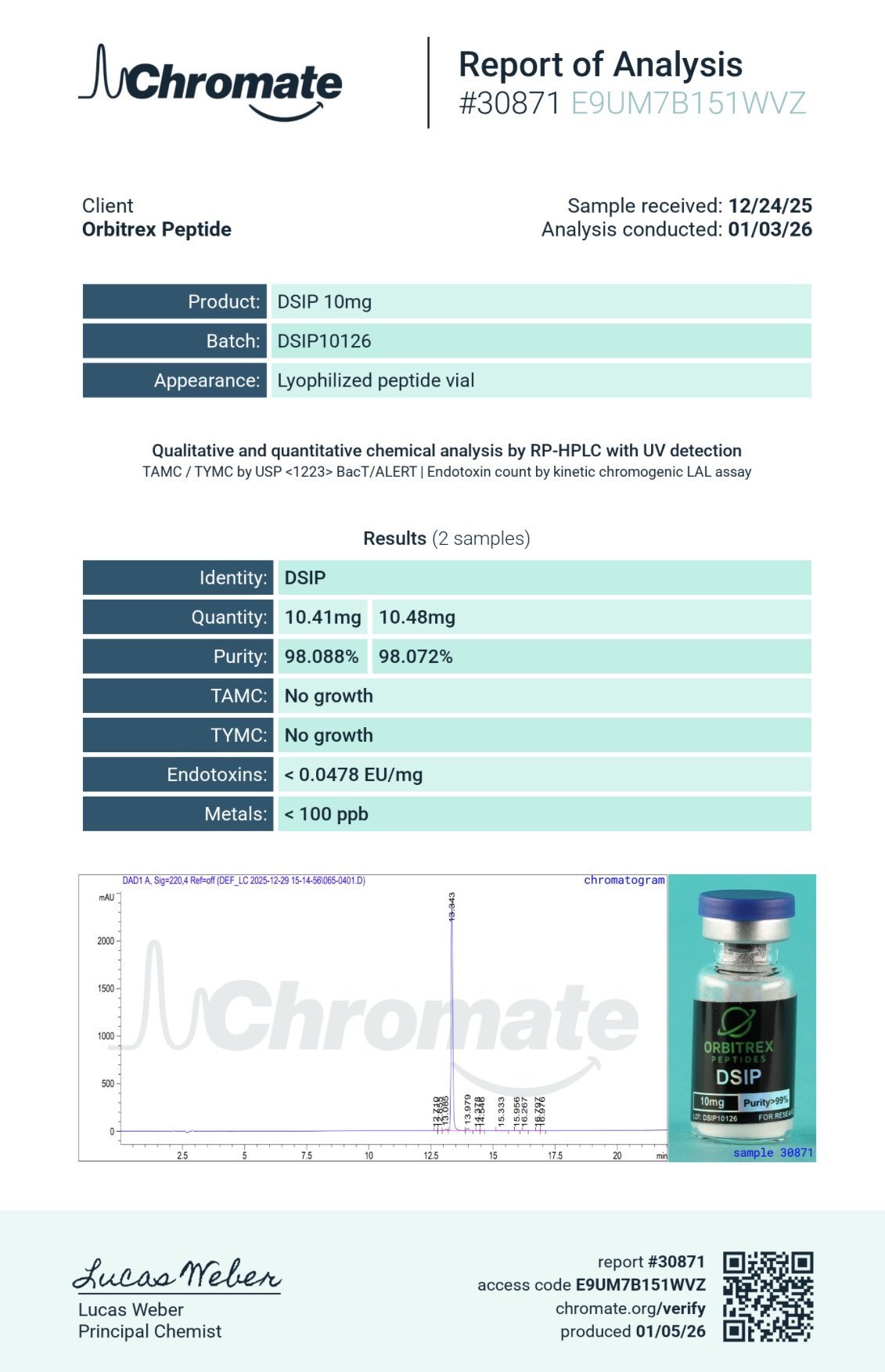
DSIP 10mg – Research Overview of Delta Sleep-Inducing Peptide
Introduction
DSIP 10mg (Delta Sleep-Inducing Peptide) is a synthetic peptide studied in scientific and laboratory research focused on sleep regulation, neurobiology, and hormonal signaling systems. The compound is often referenced in experimental studies investigating how the brain regulates sleep cycles and biological rhythms.
In research environments, DSIP 10mg is used strictly for scientific investigation purposes only. It is not approved for human or veterinary use outside controlled laboratory settings.
Interest in DSIP continues due to its potential involvement in complex neurological and physiological processes, particularly those related to sleep patterns and stress response systems.
What is DSIP 10mg?
DSIP 10mg is a small neuropeptide originally identified during research into sleep-regulating factors in the brain. It is believed to interact with multiple biological systems involved in circadian rhythm regulation and neurochemical signaling.
Although its full mechanism is not completely understood, DSIP has been studied for its potential role in:
- Sleep cycle regulation models
- Neurotransmitter signaling pathways
- Hormonal balance research systems
- Stress response mechanisms
Because of its complexity, DSIP remains an active topic in neuroscience and molecular biology research.
Scientific Interest in DSIP 10mg
The 10mg research format is commonly referenced in laboratory environments for controlled experimental use. Scientists use DSIP in small, measured quantities to maintain consistency in research models.
Key areas of interest include:
1. Sleep Biology Research
DSIP is studied to better understand how biological systems regulate sleep-wake cycles and circadian rhythms.
2. Neuroendocrine Signaling
Researchers examine how DSIP may interact with hormone-regulating systems in the brain.
3. Stress Response Studies
Experimental models explore how organisms respond to stress-related biological signals.
4. Cellular Communication Research
DSIP is also analyzed in studies focused on peptide signaling pathways and molecular communication.
Why Researchers Study DSIP
Sleep is a complex biological process influenced by multiple neural and hormonal systems. DSIP is of interest because it may play a role in these interconnected pathways.
Researchers study DSIP to:
- Investigate biological sleep regulation mechanisms
- Explore neurochemical communication in the brain
- Understand peptide-based signaling systems
- Examine circadian rhythm behavior in controlled models
These studies help expand knowledge in neuroscience, molecular biology, and physiology.
Importance of Research-Grade Quality
In scientific environments, the quality of peptides like DSIP is essential for producing reliable and reproducible data. Research-grade compounds are expected to meet strict standards such as:
- High purity verification
- Controlled laboratory synthesis
- Batch consistency testing
- Stability under proper storage conditions
- Documentation for scientific validation
Without these standards, experimental results may become inconsistent or unreliable.
Applications in Laboratory Research
DSIP is used exclusively in scientific research settings. Common experimental applications include:
- Sleep cycle and circadian rhythm studies
- Neuroendocrine system analysis
- Stress response modeling
- Brain signaling pathway research
- Molecular neuroscience investigations
These applications make DSIP relevant in advanced biological and neurological research fields.
Storage and Handling Guidelines
Proper storage is important to preserve peptide stability in laboratory environments:
- Store in a cool, dry place
- Keep away from direct sunlight and heat
- Avoid repeated exposure to moisture
- Maintain sealed conditions when not in use
- Follow laboratory safety protocols
Correct handling ensures consistent performance during experimental use.
Scientific Limitations
Although DSIP is widely studied, its exact biological role is not fully understood. Research findings vary depending on experimental conditions, biological models, and study design.
There is currently no universal consensus on its precise mechanisms, which is why ongoing research continues to investigate its function in sleep regulation and neurobiology.
Conclusion
DSIP (Delta Sleep-Inducing Peptide) remains an important subject in neuroscience and biological research due to its potential involvement in sleep regulation and neurochemical signaling. Scientists continue to study its behavior in controlled environments to better understand how complex biological systems regulate sleep and stress responses.
As research progresses, DSIP may contribute to a deeper understanding of brain function, circadian rhythms, and peptide signaling pathways.